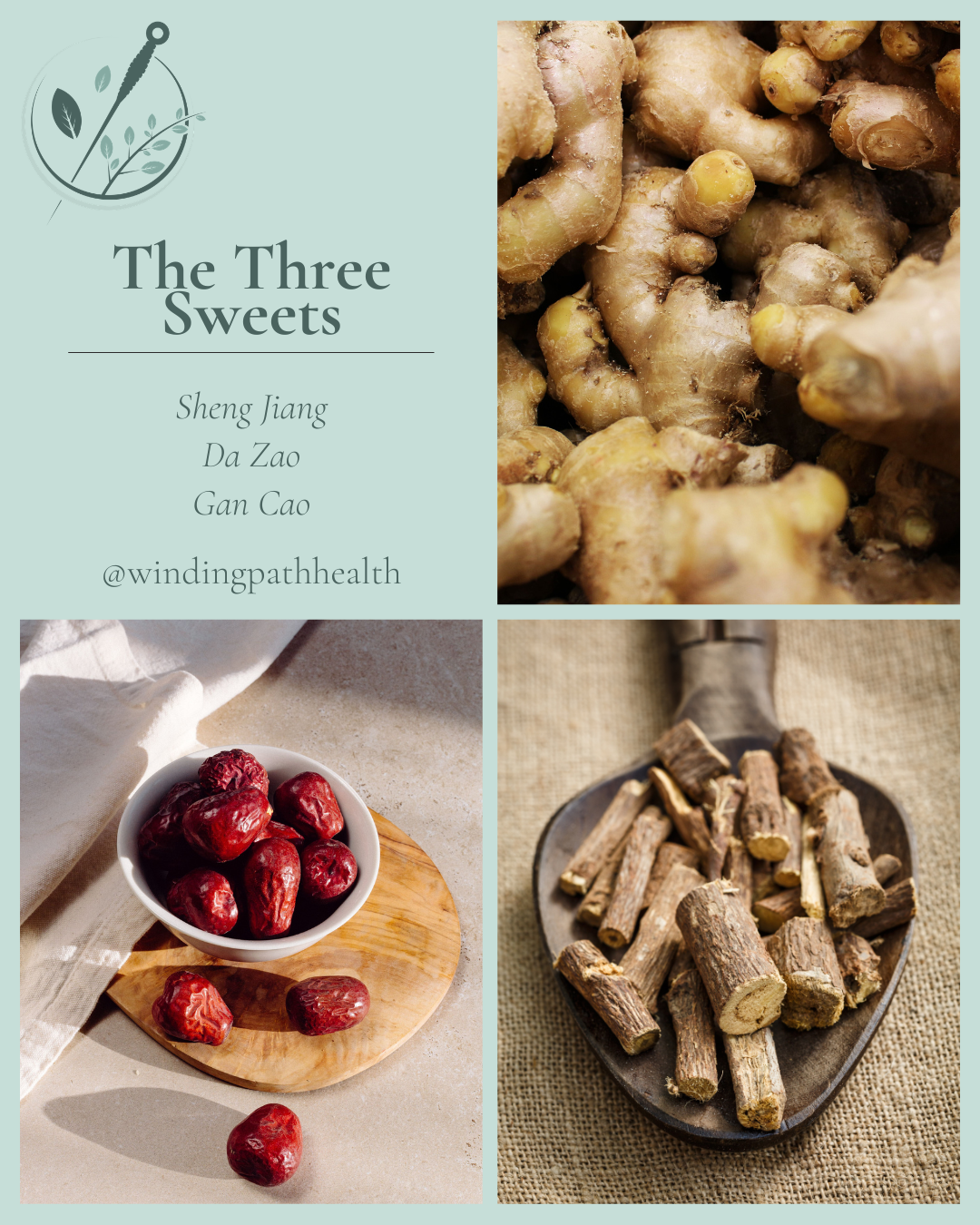
The Three Sweets - Shēng Jiāng, Dà Zăo, and Gān Căo
A Trio Worth Knowing
If you've been following The Winding Path Single Herb Series, you've already met them individually. Shēng Jiāng - the warm, acrid best friend who disperses cold and warms the middle. Dà Zăo - the generous nourisher who builds Blood, calms the Shen, and protects what is vulnerable. Gān Căo - the quiet harmonizer who travels all twelve channels and makes everything around it work better.
Together, they are something more than the sum of their parts.
In classical Chinese medicine they are sometimes called the "three sweets": Shēng Jiāng for its warming pungency that opens and activates, Dà Zăo for its rich sweetness that nourishes and anchors, Gān Căo for its extraordinary sweetness that harmonizes and protects. They are delicious together. And they are, perhaps, one of the most elegant and enduring herb combinations in the entire history of Chinese medicine.
I'll be honest, when I'm studying a formula and I see these three appearing together, something in me relaxes. I know before I've finished reading the ingredient list that this formula is going to protect the middle jiao. It's going to tonify something, nourish something. It's going to be gentle on the Spleen and Stomach. And it's going to taste good doing it. That kind of pattern recognition is one of the quiet joys of studying TCM, and the Three Sweets are one of the first combinations that starts to feel truly familiar.
A Little History
The three herbs that make up this trio have been part of Chinese medicine since its earliest recorded history. All three appear in the Shennong Bencao Jing (the Divine Farmer's Classic of Materia Medica) one of the oldest and most foundational texts in Chinese medicine, believed to codify oral traditions that predate the written record.
But it is in the Shang Han Lun (the Treatise on Cold Damage, written by Zhang Zhongjing during the Eastern Han dynasty around 200 CE) that the Three Sweets truly come into their own. Zhang Zhongjing is considered one of the greatest physicians in Chinese medical history, and the Shang Han Lun remains one of the most studied and clinically relevant classical texts in TCM education today. His formulas are still used, still taught, and still working nearly two thousand years later.
In the Shang Han Lun, the combination of Shēng Jiāng, Dà Zăo, and Gān Căo appears again and again across dozens of formulas spanning multiple categories and clinical contexts. This was not coincidence. Zhang Zhongjing understood something fundamental about how these three herbs work together — and that understanding has been passed down through generations of practitioners ever since.
What They Do Together
Individually, each of the three sweets has its own distinct personality and clinical function. Together, their combined action creates something specific and recognizable:
They harmonize the middle jiao. The Spleen and Stomach, the Earth center of TCM, responsible for transforming and transporting everything we take in, are protected and supported by this trio. Shēng Jiāng warms the middle and prevents cold from settling. Dà Zăo nourishes and builds the Spleen's capacity to receive. Gān Căo tonifies Spleen Qi and coordinates the whole. Together they create a stable, warm, receptive digestive center.
They protect against harsh herbs. Many classical formulas contain powerful substances - strong movers, aggressive drainers, warm and toxic herbs that are essential for their clinical action but potentially damaging to the middle jiao if used without support. The Three Sweets act as a protective foundation, cushioning the Spleen and Stomach from this potential damage and ensuring the formula as a whole is tolerable and sustainable.
They harmonize Nutritive and Protective Qi. Both Shēng Jiāng and Dà Zăo have specific actions on the relationship between Ying Qi (Nutritive Qi, which flows within the channels and nourishes the body) and Wei Qi (Protective Qi, which circulates on the exterior and defends against pathogens). When these fall out of balance, as they do in many exterior patterns, symptoms like spontaneous sweating, chills, and vulnerability to wind and cold arise. The Three Sweets help restore this relationship, making them particularly valuable in exterior-releasing formulas.
They make formulas more digestible. This is perhaps their most practical contribution. A formula that damages the middle jiao, tastes terrible, or causes digestive upset is a formula patients won't take, or won't take consistently. The Three Sweets increase the body's ability to receive and process the medicine, improve the overall flavor of the formula, and create the conditions for the other herbs to do their work effectively.
In the Formulas
The Three Sweets appear across an extraordinary range of classical formulas. A few worth highlighting:
Guì Zhī Tāng (Cinnamon Twig Decoction)
This is perhaps the most famous formula in the Shang Han Lun. It is a foundational exterior-releasing formula for wind-cold patterns with spontaneous sweating. Its five ingredients are Guì Zhī, Bái Sháo, Shēng Jiāng, Dà Zăo, and Zhì Gān Căo. The Three Sweets are three of the five. Here their role is explicit: harmonizing Nutritive and Protective Qi, protecting the middle jiao, and creating the warm, receptive internal environment that allows the formula to release the exterior effectively. Remove any one of the three and the formula's mechanism shifts fundamentally.
Xiǎo Chái Hú Tāng (Minor Bupleurum Decoction)
One of the great harmonizing formulas of the classical canon, used for patterns where pathogenic factors are caught between the exterior and interior, also known as the Shao Yang stage. All three sweets appear here alongside Chái Hú, Huáng Qín, Bān Xià, and Rén Shēn. In this more complex formula their role is stabilizing, anchoring the middle while the other herbs work to resolve the half-exterior, half-interior condition.
Gān Mài Dà Zăo Tāng (Licorice, Wheat, and Jujube Decoction)
This gentle, beautiful formula used for emotional distress, restlessness, and what the classics describe as visceral agitation contains Gān Căo, Fú Xiǎo Mài (floating wheat), and Dà Zăo. Two of the three sweets, working here not in a complex multi-herb formula but as the primary therapeutic agents themselves. It is a reminder that these herbs are not merely supporting players. They are clinically significant in their own right.
Bān Xià Xiè Xīn Tāng (Pinellia Decoction to Drain the Heart)
A formula for Spleen and Stomach disharmony with both cold and heat signs: epigastric fullness, nausea, diarrhea, and a complex mixed pattern. The Three Sweets anchor the middle jiao here while stronger herbs address the pathological factors above and below. Their presence is what makes this formula tolerable and sustainable for a digestive system that is already under stress.
Why This Matters
Understanding the Three Sweets is one of the first steps toward understanding how Chinese medicine thinks about formula design, not as a collection of individual herb actions added together, but as a relational system where each ingredient affects every other, and where the foundation matters as much as the active agents.
The Three Sweets are that foundation. They are what allows a formula to be both effective and sustainable. They protect the very system, the Spleen and Stomach, that is responsible for transforming the medicine into something the body can actually use. Without that foundation, even the most elegantly designed formula can cause more disruption than healing.
There is a wisdom in this that extends beyond herbalism. Good medicine of any tradition understands that how you deliver a treatment matters as much as what the treatment is. That protecting the receiver is part of the healing. That harmony is not a luxury but a prerequisite.
Shēng Jiāng, Dà Zăo, and Gān Căo understood this two thousand years ago.
They still do.
This post is part of The Winding Path Single Herb Series. Read the individual herb posts: [Shēng Jiāng], [Dà Zăo], [Gān Căo].
For educational purposes only. Please consult a qualified healthcare provider before using herbs therapeutically. Full disclaimer [here].